This week the AP style book suggested that writers should not refer to emergencies as “incidents.” This caused some good chatter among emergency and risk management professionals, who say incident all the time, so much so that the word is encoded in systems for managing emergencies (FEMA encourages all emergency management organizations to use a system called the National Incident Management System, for example).
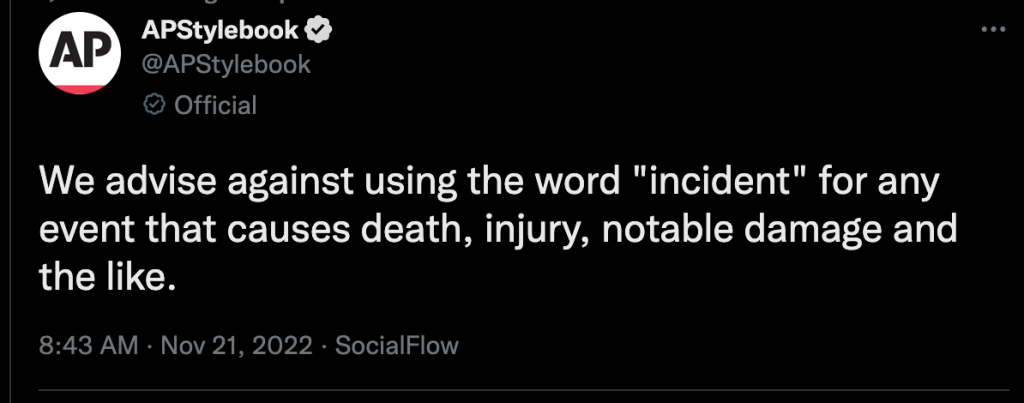
Incident is a funny word, isn’t it? Incidentals tend to mean accidental hotel room damage. We say incidentally when we really mean “by the way.” So how did we end up using this word as a semi-euphemism to mean “something very bad has occurred?” Here’s a brief history (that I wrote in grad school but am editing to make a bit less of a snooze).
The word incident, to get really nerdy, appeared in English in the early 1400s, stemming from the French word incident, meaning liable to occur or likely to happen, and inspired by the Latin incidĕre, meaning to fall into or upon, from cadĕre, meaning “to fall.” Incident is defined as “something that occurs casually in the course of, or in connection with, something else, of which it constitutes no essential part.” It wasn’t until the 1900s that incident got its emergency denotation, and a second definition emerged: “an occurrence or event, sometimes comparatively trivial in itself, which precipitates or could precipitate political unrest, open warfare, etc.”
Incident appeared in The Annual Register of World Events in 1912 to describe “the Agadir incident,” an event that caused tensions between France and Germany. In 1911, Germany attempted to challenge France’s control of Morocco by sending a gunboat into the Moroccan city of Agadir, causing talk of war between France and Germany. Britain intervened and encouraged peace, and the two countries signed a treaty. In most historical texts, this is referred to as the “Second Moroccan Crisis” or the Agidir Crisis, demonstrating that crisis and incident were growing closer together in language use during this time.
The theme of this article is basically that war shapes languages and practices simultaneously, because just as the word incident was changing use, emergency management was busy becoming a thing after World War II and during the Cold War. After WWII, private defense companies sought other employment as they were cut from the Department of Defense budget, and one of these contractors, Aerospace Corporation, was hired by the US Forest Service to study improve wildland firefighting operations.
In 1970, California experienced a bad fire season, and the US Forest Service assessed their efforts, finding that confusion about terminology and operating procedures led to problems among firefighting teams. Aerospace Corporation led a new project called FIRESCOPE, a research and development team that developed a single system to improve operations. FIRESCOPE led to the creation of Incident Command System (ICS), designed to ensure coordinated actions during a fire. Here, incident took on its significance to emergency response.
The ICS system was viewed as more of a “management model” built around the goals of command, planning, operations, logistics, and finance. That incident is often placed next to the words “management” and “command” in these years indicates that after WWII, incident became a word to define and manage natural disasters.
The Incident Command System started out in wildland firefighting, but became a US-wide system after the 9/11 terrorist attacks. Similar to firefighting self-studies that led to the creation of ICS, the official 9/11 Commission Report found that a lack of coordination among security organizations was in part responsible for the attacks. In 2004, the newly-created Department of Homeland Security launched the National Incident Management System (NIMS). NIMS was implemented as “a consistent nationwide template” to enable multiple organizations to work together to prevent and respond to incidents of all sizes and complexities.
So, why aren’t we just saying “emergency”? Average citizens of the US are told to be prepared for emergencies—incident is employed by emergency management insiders, while the word emergency is used to educate the public about their role in security.
The word incident has both military and natural disaster legacies behind it and links emergencies to systems, hierarchies, and terminologies to manage those issues. Incident is an example of insider jargon that has a long history and relates to key changes in how we look at and deal with climate disasters and human security threats, and ultimately ties the two together.
 Risk Blog
Leave a comment